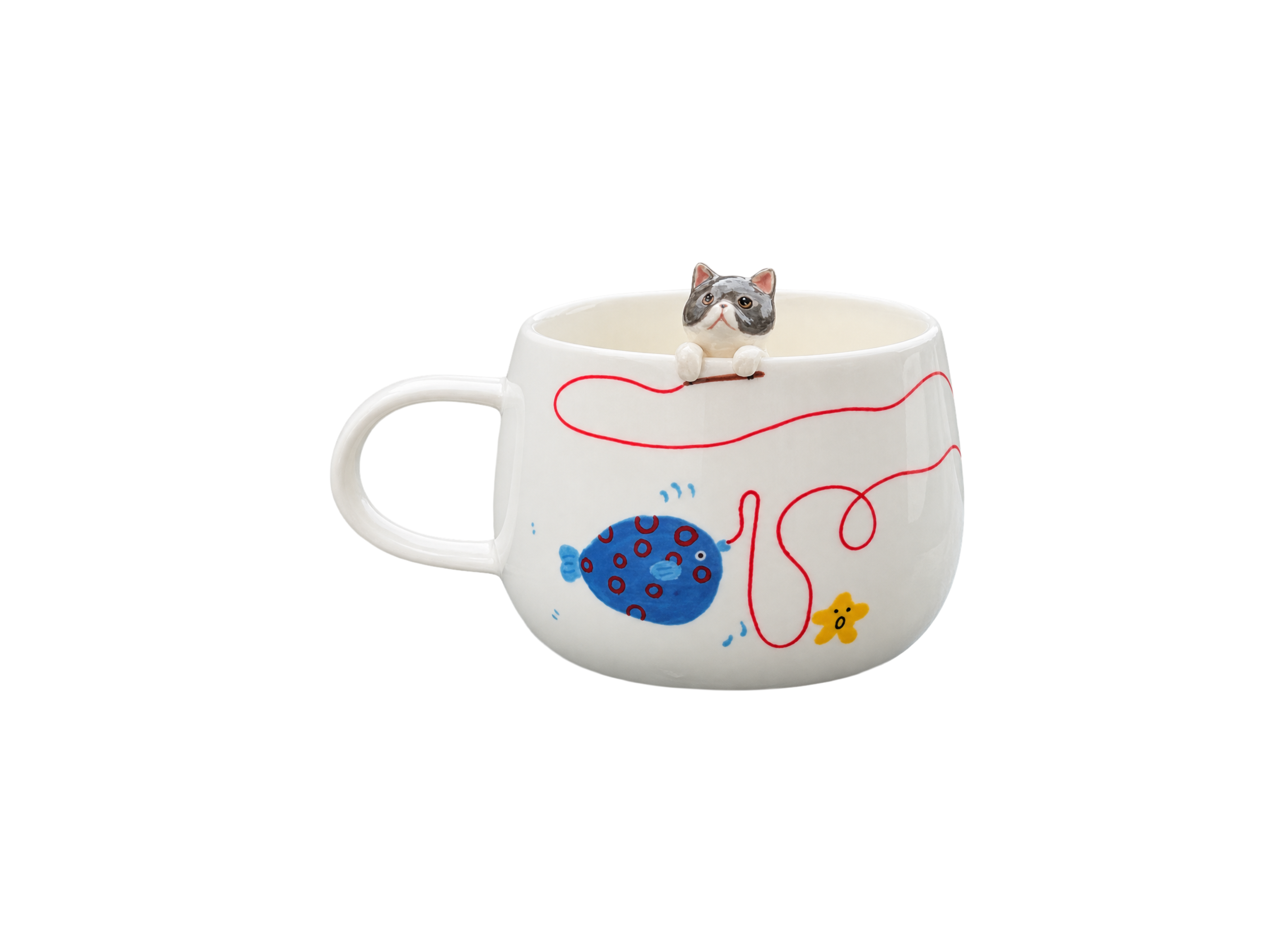
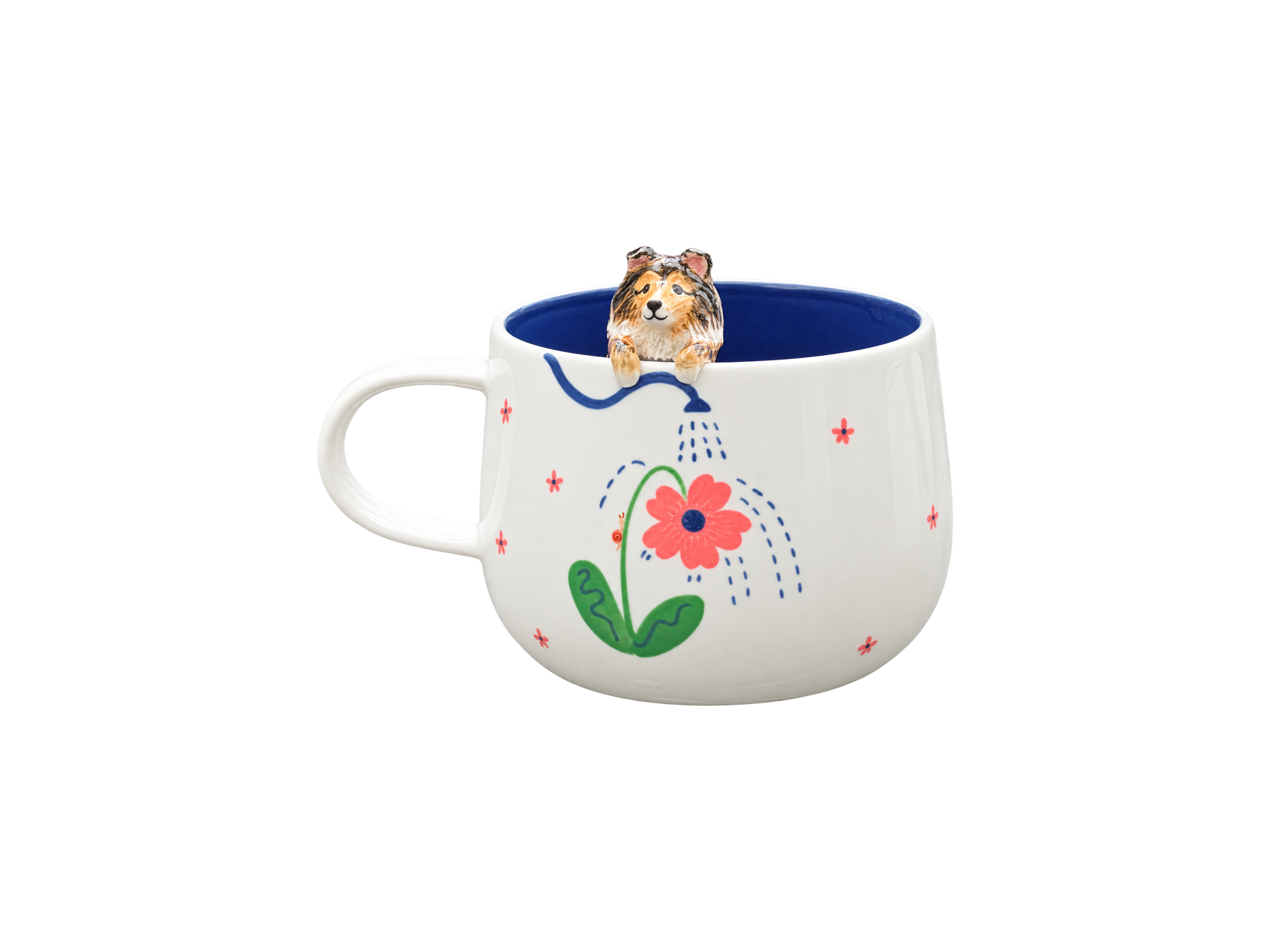
A printed mug directly reproduces a photograph or an illustration on a smooth surface. A hand-painted mug, on the other hand, transforms the animal's features through the artist's eye and gesture. The former is particularly suitable for a precise image; the latter, for a personal interpretation, possibly enriched with reliefs or a figurine. The right choice therefore depends on the memory you wish to preserve.
Two Personalized Objects, but Two Different Intentions
A printed mug and a hand-painted mug can start from the same photograph. However, they do not necessarily aim to produce the same result.
Printing preserves the image as an image. It can reproduce a gaze, a background, a pose, or a specific moment. Manual painting, on the other hand, uses the photograph as a source of observation: the artist identifies the colors, the shape of the face, the markings of the fur, and the expression, then adapts them to the shape and world of the piece.
It is not a matter of designating one technique as better than the other. The real question is more intimate: do you want to find a familiar photograph or discover a new interpretation of your companion?
What is a Custom Printed Mug?
The term "printed mug" covers several processes. Thermal sublimation is one of the most common for photo mugs, but not all printed products necessarily use this method.
During sublimation, the image is first printed on transfer paper. Under the effect of heat and pressure, the inks are transferred to a substrate with a compatible coating. Epson describes this process as a transformation of the ink that allows it to be integrated into a prepared surface, particularly that of certain ceramic mugs.
This technique generally allows:
- to reproduce a color photograph;
- to preserve many visual details;
- to integrate text, a date, or a first name;
- to reproduce several copies with the same visual;
- to obtain a personalized surface that remains smooth to the touch.
However, the rendering depends on the quality of the file, the mug's coating, the inks, the transfer, and the settings used. The single word "printed" is therefore not enough to know the quality or resistance of a product.
Before ordering, it is useful to ask what technique is used and what care instructions precisely accompany the chosen mug.
What is a Hand-Painted Mug?
In a hand-painted creation, the image is not automatically transferred to the piece. It is observed, drawn or adapted, then realized by the artist's hand.
At Maison Scott, photos are used to study the animal's characteristic features, its colors, its fur, its expression, and its peculiarities. The portrait is then integrated into the composition and style of the chosen collection.
The "À la pêche!" mug product page specifies that the piece is individually molded and painted, with underglaze decoration and high-temperature firing. It also indicates that the desired style is illustrative, artistic, and not photorealistic.
This means that the final result does not seek to reproduce every pixel of the photograph. Certain shapes can be simplified, certain colors adapted to the composition, and certain details highlighted because they make the animal immediately recognizable.
When a figurine is added, the personalization is no longer limited to the surface of the mug: it also occupies a volume. The shape of the ears, the muzzle, the posture, or the tail can then contribute to the resemblance.
Quick Comparison
| Criterion | Printed Mug | Hand-Painted Mug |
|---|---|---|
| Relationship to the Photo | Direct reproduction of the visual | Interpretation from photos |
| Rendering | Photographic or graphic | Illustrative, marked by the hand |
| Surface | Generally smooth | Paint, texture, or relief depending on the model |
| Figurine in Volume | Usually absent | Possible depending on the creation |
| Repetition | The same file can be reproduced | Each creation has slight variations |
| Artist's Role | File preparation and placement | Observation, composition, painting, and sometimes molding |
| Photos Needed | One good quality image may suffice | Several angles can help understand the animal |
| Care | Depends on the process and manufacturer | Depends on the glaze, reliefs, and finishes |
| Expected Result | Finding a precise image | Finding the animal in a new visual universe |
1. Do you want to preserve a specific photo?
Some photographs are inseparable from the memory they carry: a dog sleeping in its favorite armchair, a cat looking out the window, or an image taken during a trip.
If the background, light, and moment are as important as the animal itself, a printed mug can be the most direct choice. It allows you to preserve the scene as a whole.
A hand-painted mug necessarily makes a selection. The artist can preserve the gaze, a position, or a particular mark, but will not automatically reproduce every element of the photograph.
So ask yourself what you want to see again when you pick up the mug: the image of a moment or the recognizable presence of your animal?
2. Do you prefer photographic resemblance or an interpretation?
Resemblance does not always mean the same thing.
In a photo mug, it mainly relies on the fidelity of the print to the submitted file. If the photograph is clear and correctly exposed, the result can retain fine nuances of the fur and expression. Conversely, blur, filters, and low definition are also likely to be reproduced.
In a hand painting, resemblance relies more on the selection of essential characteristics. A spot around the eye, a slightly tilted ear, or a familiar expression can count more than an exact reproduction of every hair.
Maison Scott explains in its FAQ that its creations constitute an artisanal interpretation and not a mechanical or photographic reproduction. Slight variations in shape, texture, color, or brushstrokes are part of the handmade result.
If you are looking for a faithful copy of a photograph, printing more directly meets this expectation. If you appreciate an artist translating the animal's identity into their own language, manual painting is more consistent.
3. Are relief and physical presence important?
A printed image remains primarily attached to the surface of the mug. A sculpted creation can bring the animal into the very form of the object.
A figurine placed on the edge, integrated inside the cup, or associated with a small scene creates a different presence. You no longer just look at a portrait: you also discover a silhouette, a posture, and a volume.
However, this approach requires more visual information. A front-facing photograph does not always allow for understanding the length of the muzzle, the shape of the back, the distribution of colors on the body, or the appearance of the tail.
For a figurine, if possible, prepare front, profile, three-quarter, and full-body views. The Maison Scott guide on choosing reference photos explains how to put together this collection without professional photographic equipment.
4. Do you want several identical objects?
Digital printing is suitable for reproducing the same file. Several mugs can thus present a very similar visual, subject to normal variations in the medium and process.
A handcrafted piece cannot be repeated perfectly identically. Even when the artist uses the same photos, the modeling, brushstrokes, glazing, and firing can produce slight differences.
This variation can be sought after when wishing to offer a unique object. It may be less suitable if the goal is to create a perfectly uniform series, for example for an event or professional use.
If you order several artisanal creations, you must therefore decide whether you want a common composition with small natural differences, or a strictly identical reproduction.
5. How to compare price and lead time?
The technique gives an indication of the work involved, but it alone does not allow for deducing a precise price or lead time.
A printed mug may involve file preparation, printing, transfer, and quality control. A hand-painted or molded mug requires a succession of artisanal interventions. At Maison Scott, these include photo analysis, design, modeling, drying, firings, painting, glazing, and final inspection.
These differences explain why the two objects should not be compared solely on their appearance in a photograph.
Always check the price and lead time displayed on the product page at the time of order. They may vary depending on size, number of animals, options, complexity, and period.
Which technique is the most durable?
There is no universally valid answer for all printed mugs or all painted ceramics.
A properly performed sublimation on a compatible coating is designed to integrate the ink into that surface. Epson specifies that sublimation requires a suitable substrate and that the manufacturer's cleaning recommendations must be followed.
For a hand-painted piece, durability depends notably on the decoration technique, the glaze, the firing, any reliefs, and the finishes. Maison Scott indicates using underglaze painting and high-temperature firing for the models concerned. Its FAQ nevertheless recommends hand washing for creations with reliefs or delicate details.
A mention like "artisanal", "printed", or "ceramic" therefore does not, by itself, guarantee dishwasher or microwave compatibility.
Before purchasing, check:
- the product-specific instructions;
- the presence of embossed elements;
- any metallic finishes;
- dishwasher compatibility;
- microwave compatibility;
- recommendations regarding thermal shocks.
And the safety of food contact?
The decorative method and food contact suitability are two distinct issues.
In the European Union, EC Regulation No 1935/2004 stipulates that materials intended for food contact must not transfer their constituents in quantities that could endanger human health, change the composition of food in an unacceptable way, or deteriorate its organoleptic characteristics.
The DGCCRF also reminds that these rules apply specifically to tableware and containers.
Therefore, a beautiful artisan ceramic is not automatically intended for beverages. Similarly, a decorated or printed mug must be sold for this purpose and comply with applicable requirements.
Look for an explicit indication such as "suitable for food contact" on the product sheet. If the object is presented only as decorative, do not assume it can be used as a cup.
Which choice for a dog or cat portrait?
Choose a printed mug if:
- you want to preserve a particular photograph;
- the background or the moment is part of the memory;
- you prefer a photographic rendering;
- you want to reproduce the same visual on several objects;
- you are not looking for relief or modeling.
Choose a hand-painted mug if:
- you want an artistic interpretation of your animal;
- its features can be reconstructed from several photos;
- you like to see the gesture, nuances, and variations;
- you are looking for a figurine or a three-dimensional presence;
- you want to integrate your companion into a particular graphic universe.
In both cases, the quality of the photos remains important. A print will reproduce the qualities and flaws of the file. An artist can compare several references, but cannot know with certainty a detail that no image shows.
The eight questions to ask before deciding
- Is it the photograph itself that I want to preserve?
- Do I accept a non-photorealistic interpretation?
- Do I have multiple angles of my animal?
- Do I want a figurine or just an image?
- Will the object be used daily or primarily kept?
- What are the washing and heating instructions?
- Does the product sheet confirm suitability for food contact?
- Are the price, lead time, and customization conditions clearly indicated?
You can supplement this comparison with the eight criteria to check before ordering a personalized mug.
Choosing how the memory should live
A printed mug preserves an image. A hand-painted mug offers an encounter between this image, the material, and the artist's eye. Both can carry a precious memory, but they tell it in different ways.
Before choosing, look at several finished creations, read the description of the technique carefully, and observe what spontaneously moves you. The Maison Scott Gallery allows you to discover different ways of integrating a companion into a ceramic creation.
The right object is not necessarily the one that looks most like a photograph. It is the one whose presence feels most right to you.
FAQ
Is a printed mug less durable than a hand-painted mug?
Not necessarily. Durability depends on the printing process, coating, glaze, firing, reliefs, and recommended care for the product concerned.
Can a hand-painted mug look exactly like the photo?
It can retain the recognizable features of the animal, but the result remains an artistic interpretation and not an exact photographic reproduction.
Which solution to choose with a single old photo?
A print allows you to directly preserve this image. Manual painting remains possible if the photo shows enough details, but the artist should not be expected to reconstruct unseen parts with certainty.
Can both types of mugs be put in the dishwasher?
This depends on the product. You must follow the manufacturer's or workshop's instructions, especially in the presence of reliefs, metallic finishes, or delicate details.
How do I know if a mug is suitable for beverages?
The product sheet must explicitly state that it is intended or suitable for food contact. The appearance of the mug alone is not sufficient to determine this.