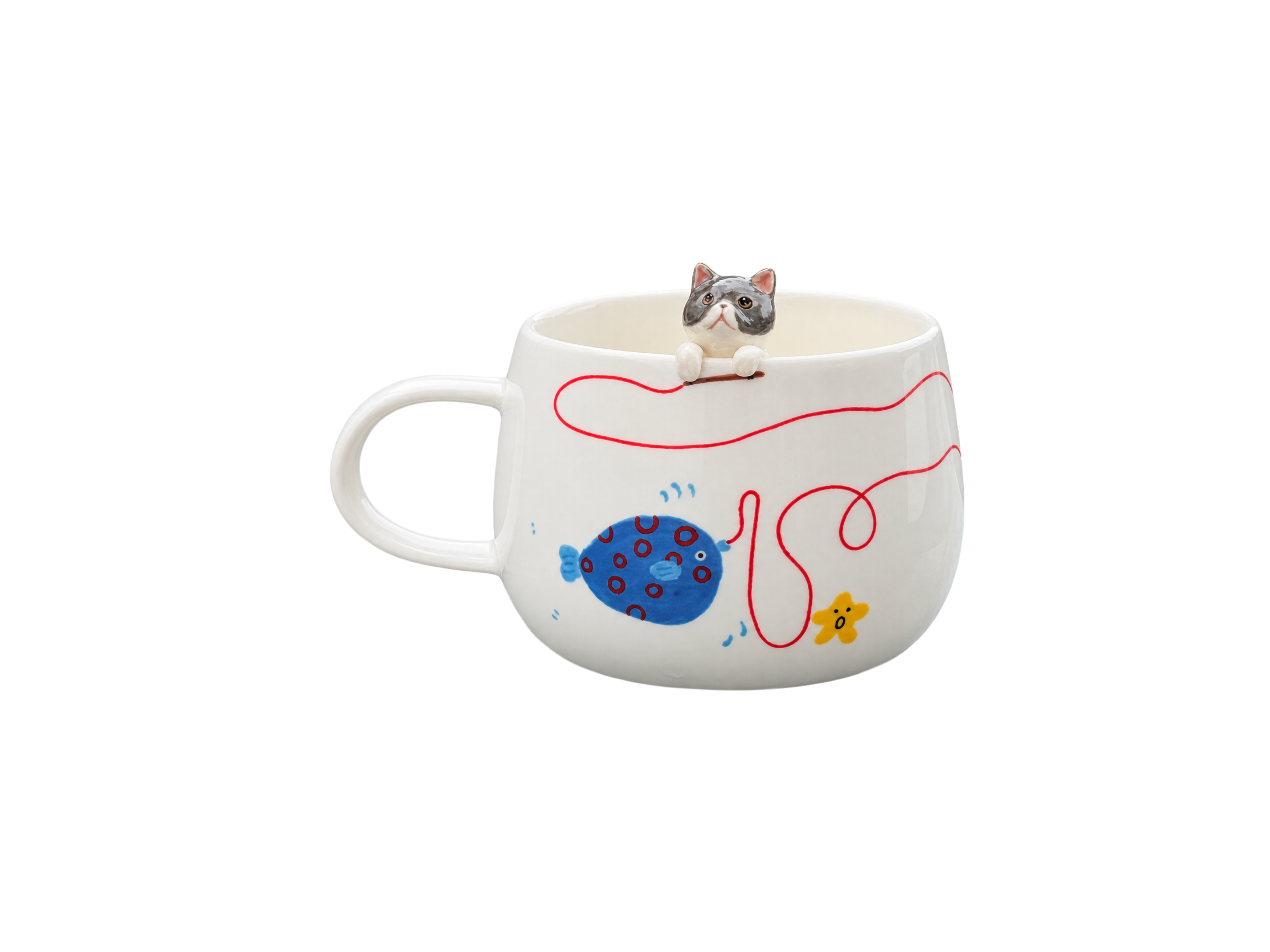
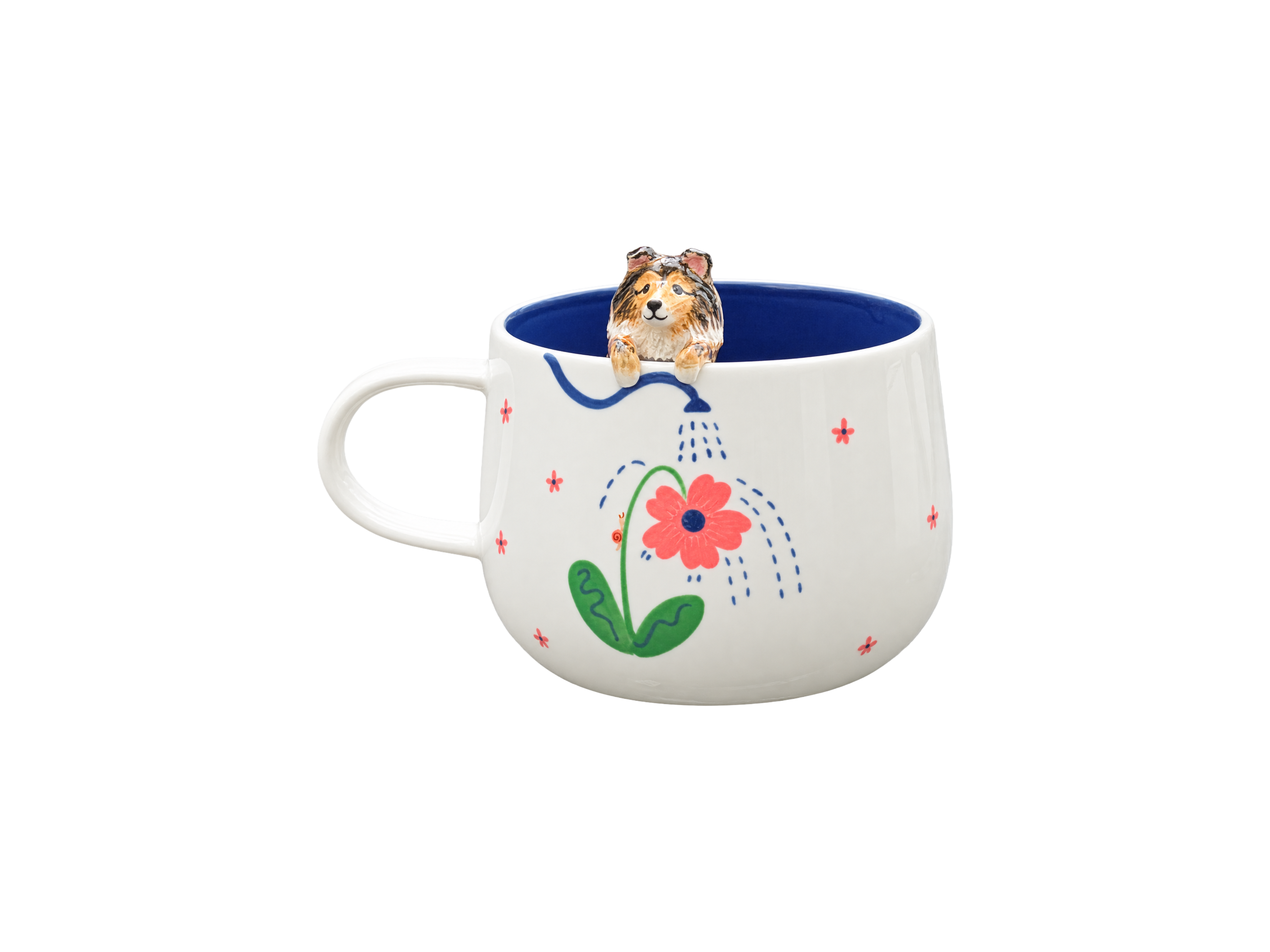
A porcelain cup is always a ceramic, but not all ceramics are porcelain. Earthenware, stoneware, and porcelain all belong to the same family, with different bodies and firing processes. To choose a custom cup, however, look at the finished product: specific material, glaze, decoration, reliefs, food contact suitability, and care instructions.
Ceramic is not a single material
In everyday language, a "ceramic cup" is often contrasted with a "porcelain cup". This phrasing is practical but technically imprecise.
The word ceramic refers to a family of materials and objects obtained from mineral substances that have been fired. Porcelain, stoneware, earthenware, and terracotta all belong to this family.
The educational page of Sèvres – Manufacture et Musée nationaux, an institution under the patronage of the French Ministry of Culture, distinguishes two main groups:
- pottery and earthenware, whose body remains porous and must be waterproofed when intended for certain uses;
- stoneware and porcelain, whose body is vitrified throughout by firing.
Thus, when a product sheet indicates only "ceramic", it provides a general category. To find out if it is porcelain, stoneware, or another body, further clarification is needed.
The four words to know
| Term | What it designates | General characteristic |
|---|---|---|
| Ceramic | The general family | Mineral object shaped then transformed by firing |
| Earthenware | A ceramic with a porous body | Impermeability depends on the coating or glaze |
| Stoneware | A ceramic vitrified at high temperature | Dense and impermeable body throughout |
| Porcelain | A vitrified ceramic, generally white | Characteristic whiteness and translucency depending on the body |
This table helps to understand the categories, but it does not automatically classify the quality of a cup. Two pieces made in the same family can have very different shapes, thicknesses, decorations, and uses.
What is earthenware?
Earthenware is a ceramic whose body remains porous after firing. It is traditionally covered with a coating or glaze that helps to waterproof it and creates a surface suitable for decoration.
It can be white, colored, shiny, or matte depending on the body, glaze, and technique used. Its visual appearance is therefore not always sufficient to immediately distinguish it from another ceramic.
Earthenware offers a long decorative tradition, but the word alone does not tell whether a cup can hold a drink, go in the dishwasher, or be placed in the microwave. These uses depend on the finished piece and the instructions provided with it.
What is stoneware?
Stoneware is a ceramic fired at high temperatures. According to Sèvres, its body contains a high proportion of silica and becomes partially vitrified during firing. It is then impermeable throughout.
Stoneware is often associated with tactile surfaces, natural hues, or a certain material presence. However, it can be very light, colored, enameled, or particularly finely worked. It should not be reduced to a rustic aesthetic.
For a custom creation, stoneware can offer a warm and very earthy visual language. But it is not automatically more solid or more suitable for everyday use than a porcelain piece: the shape, thickness, firing, reliefs, and intended use must also be taken into account.
What is porcelain?
Porcelain is also a ceramic whose body is vitrified throughout. It is generally distinguished by its whiteness and translucency.
In European hard-paste porcelain, kaolin is one of the characteristic materials of the body. However, there are several families of porcelain and different formulations. A simplified definition should therefore not be used to guess the precise composition of a product.
The whiteness of porcelain can provide a particularly legible background for a hand-painted animal portrait. The nuances of the fur, the eyes, and distinctive markings can stand out clearly on this surface. This is nevertheless an artistic choice: the quality of the portrait also depends on the drawing, colors, firing, and manual work.
At Maison Scott, the product sheet for Corail des mers, for example, specifies the use of a porcelain cup. This indication concerns this particular reference and should not be automatically extended to the entire catalog without checking each product sheet.
Porcelain or ceramic: which is of higher quality?
The question is based on a false opposition, since porcelain is itself a ceramic.
The name of the body is not enough to establish a universal hierarchy. To judge a custom cup, several elements must be observed:
- the regularity and balance of the shape;
- the comfort of the handle and rim;
- the stability of the cup;
- the quality of the surface and glaze;
- how the decoration is applied and fired;
- the solidity of the modeled elements;
- suitability for the announced use;
- the finishes and inspection of the finished piece.
A porcelain poorly suited for its use is not preferable to a well-designed stoneware. Conversely, a thick cup is not necessarily more durable than a thinner cup: its geometry and stress points also play a role.
The term used can inform about the material family, but quality is judged on the object as a whole.
Which material is best for an animal portrait?
For a painted portrait, a clear and regular surface generally facilitates the readability of the eyes, contours, and colors. This is one reason why white porcelain is often appreciated in decorated tableware.
This does not mean that a portrait cannot be painted on stoneware or another ceramic. On a warmer or darker body, the decoration can create a different result: more contrasted, more mineral, or more integrated into the material.
The right choice therefore depends on the desired style:
- for a bright rendering and easily distinguishable colors, a white surface may be preferred;
- for a more organic atmosphere, the natural color of the body can contribute to the decoration;
- for a relief figurine, one must also consider how the body lends itself to modeling and how the relief is attached to the piece;
- for regular use, handling and maintenance are as important as appearance.
At Maison Scott, the material serves as a support for an artistic interpretation of the animal. It does not replace the quality of the photographs provided, nor the choice of details that will make the portrait or figurine recognizable.
Does the type of ceramic determine dishwasher suitability?
Not by itself.
A cup can be made of porcelain or stoneware and still have a decoration, finish, or reliefs that require more delicate care. Conversely, some ceramic pieces are designed to withstand regular daily use.
Specifically, you should check:
- the decoration technique;
- the presence of metal elements;
- modeled relief parts;
- manufacturer's instructions;
- recommended washing temperature and program.
For Maison Scott creations with delicate relief elements, hand washing remains the preferred precaution. The article on caring for custom mugs can be linked here to avoid repeating all recommendations.
The same rule applies to microwaves: the word porcelain alone does not constitute authorization. A metallic finish, for example, changes the conditions of use.
Is a ceramic automatically suitable for food contact?
No. A cup must be evaluated as a finished object intended for a specific use.
The DGCCRF reminds us that objects intended for food contact must comply with a principle of inertia: under their normal or foreseeable conditions of use, they must not release constituents in quantities likely to present a danger, unacceptably modify food, or alter its properties.
This requirement applies particularly to objects made of porcelain, earthenware, stoneware, or pottery. The mere fact that an object has the shape of a cup does not therefore allow one to conclude that it is suitable for beverages.
Before purchase, look for a clear indication of the intended use. A decorative piece and a cup intended for coffee should not be considered in the same way.
Maison Scott indicates in its FAQ that its pieces intended for daily use feature underglaze decoration and are suitable for food contact. This statement must remain linked to the relevant references and consistent with the information on each product sheet.
How to correctly read a product sheet?
To avoid choosing solely based on a photograph, check the following six points.
1. The exact material
Does the sheet specify porcelain, stoneware, or just ceramic? If the term remains general, it is legitimate to ask for clarification when this information influences your decision.
2. The announced use
Is the object presented as a usable cup, a decorative piece, or both? A shape resembling a container is not sufficient.
3. The decoration technique
A printed portrait, a fired painting, an underglaze decoration, and a metallic finish do not necessarily require the same precautions.
4. The presence of reliefs
A modeled figurine adds volume, but it must also be taken into account when storing, washing, and handling.
5. Care instructions
Look for explicit information regarding hand washing, dishwashing, and microwave use. Do not extrapolate from the material alone.
6. Consistency of information
The product sheet, FAQ, and any instructions included with the package must be consistent. If in doubt, ask for confirmation before using the piece in an unindicated manner.
So, what material to choose for a custom cup?
Start with the use and aesthetics, rather than a supposed hierarchy between materials.
Choose a creation on a white surface if you want to emphasize the eyes, the colors of the fur, and the legibility of the portrait. Prefer a visually more present material if you want the body and glaze to contribute as much to the object as the decoration.
If the creation includes a modeled figurine, also observe the relief, the grip, and the care gestures. If it is to be used daily, always check its suitability for food contact and washing conditions.
Finally, read the precise name of the material on the product sheet of the chosen creation. Ceramic describes a large family; porcelain, stoneware, or earthenware provide more specific information. But it is the complete work of the piece and its declared use that truly allow for an informed choice.
You can browse the Maison Scott Gallery to observe how the surface, painted decoration, and modeled elements interact in the finished creations.
FAQ
Is porcelain a ceramic?
Yes. Porcelain is a category of ceramic, just like stoneware and earthenware. Simply contrasting "porcelain" and "ceramic" is therefore technically imprecise.
What is the main difference between porcelain and earthenware?
Porcelain is vitrified throughout and generally impermeable after firing. Earthenware's body remains porous and is covered with a coating or glaze that helps waterproof it.
Is stoneware stronger than porcelain?
There is no universal answer. The resistance of a cup also depends on its formulation, firing, thickness, shape, glaze, and any reliefs.
Are all porcelain cups dishwasher safe?
No. The decoration, finishes, and modeled elements may require hand washing. You must follow the instructions specific to each product.
Is a ceramic cup automatically suitable for beverages?
No. You must verify that the finished object is indeed intended for food contact. Some ceramic pieces are exclusively decorative.