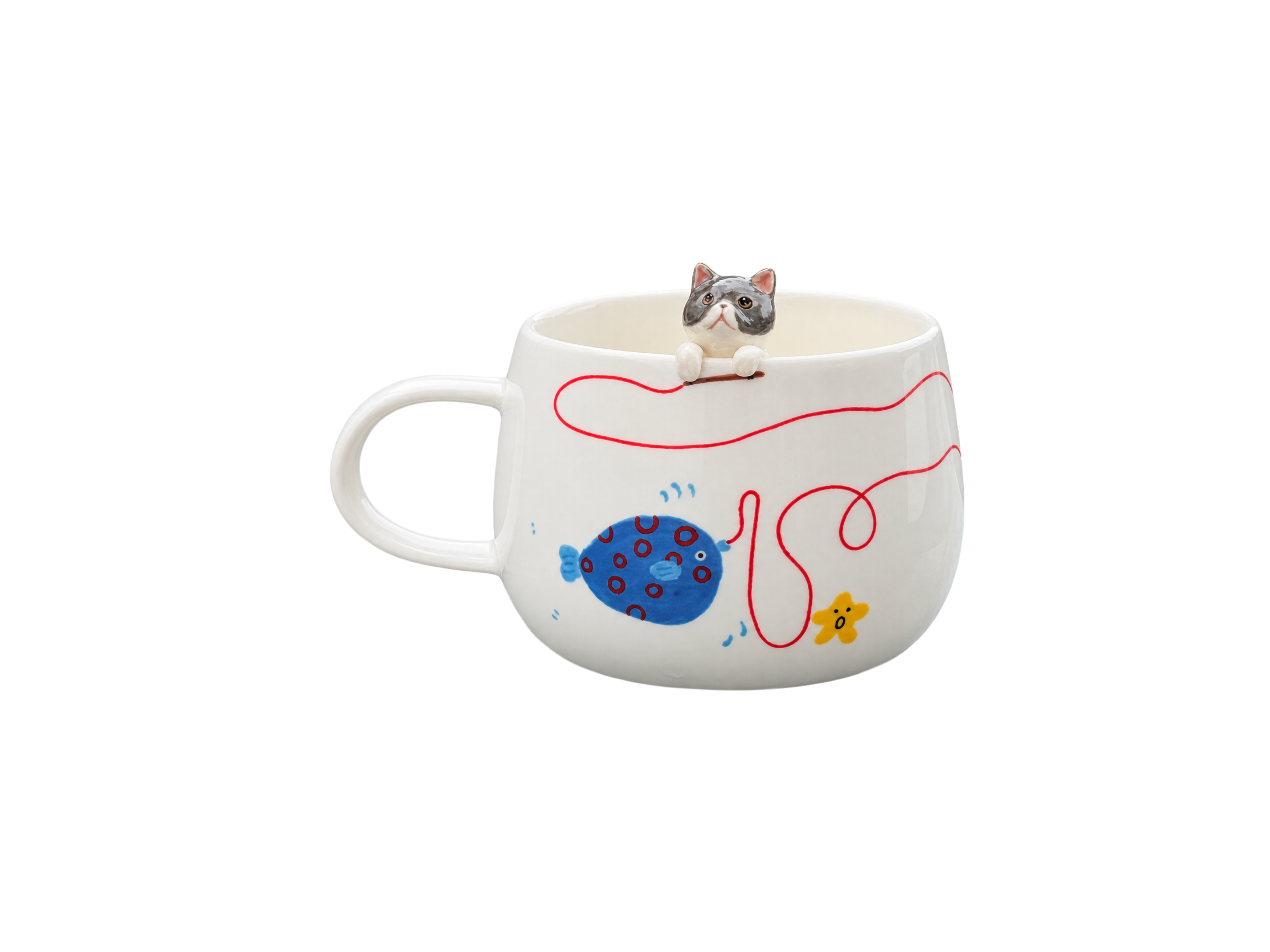
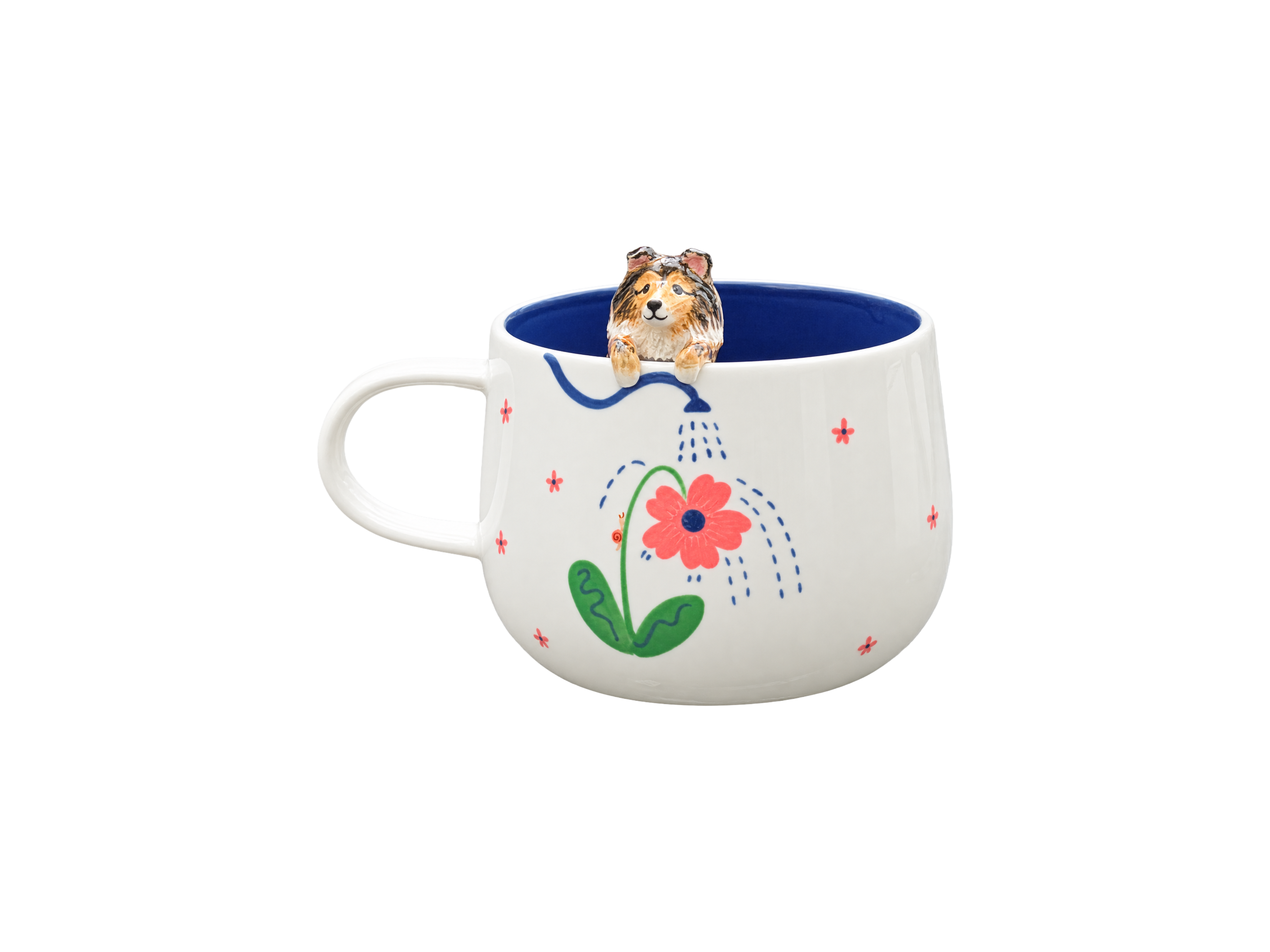
Choose a painted portrait if you want to highlight the gaze, fur colors, and facial markings. Opt for a sculpted figurine if the silhouette, posture, or a familiar attitude seems more important to you. Neither approach is superior to the other: the right choice mainly depends on what you immediately recognize in your pet.
Two Different Ways to Tell the Story of the Same Animal
A painted portrait primarily works with line, color, light, and visible details on a surface. A sculpted figurine adds volume: the ears stand out, the muzzle takes shape, and the posture becomes perceptible from multiple angles.
This difference is linked to the very gestures of ceramics. The Institut National des Métiers d’Art reminds us that a ceramist transforms clay or porcelain through modeling, firing, and decoration. Painting and sculpting thus belong to the same artisanal world but do not highlight the same aspects of a subject.
At Maison Scott, these approaches are not always entirely separate. A figurine can be painted to replicate fur colors, while a portrait can be integrated into a more elaborate ceramic composition.
| Criterion | Painted Portrait | Sculpted Figurine |
|---|---|---|
| Most Expressive Element | Gaze, face, colors | Silhouette, posture, volume |
| Visual Effect | Delicate, graphic, frontal | Sculptural, tactile, visible from multiple angles |
| Priority Photos | Clear face, eyes, fur | Front, profile, full body, tail, and paws |
| Integration into a Mug | Painted decoration on the surface | Relief element or small scene |
| Sensitivity to Handling | Depends on decor and finish | Reliefs more exposed to shocks |
| Ideal if… | You recognize your pet by its expression | You recognize it by a posture or attitude |
When to Choose a Painted Portrait of Your Pet?
When its Gaze is What You Notice First
Some animals have an instantly recognizable expression: a very gentle gaze, an eye surrounded by a spot, light eyebrows, or a particular way of tilting their head.
In this case, the painted portrait offers a natural space to work on the eyes, muzzle, and color transitions. A clear photo taken at face level helps to understand these details without inventing them.
The portrait is particularly suitable when your memory is linked to an expression: the attentive gaze of a dog waiting for its walk, the calm look of a cat settled near a window, or a slight asymmetry that only its loved ones notice.
When Fur Colors and Markings Matter a Lot
A white stripe on the forehead, darker ears, reddish spots, or a mask around the eyes can be essential for resemblance.
Painting allows these colors to be distributed on the surface of the mug and to build a legible composition, without having to transform each hair into relief. It is therefore well suited for animals whose visual identity relies on fur and facial contrasts.
The Corail des mers creation illustrates how a painted portrait can be integrated into the decorative universe of a mug and its saucer.
When You Are Looking for a Discreet Presence
The painted portrait generally maintains a more subdued outer silhouette. It can be adapted for someone who wants to use or display a personalized mug without adding a very prominent sculpted element.
The result is not necessarily less personal. It simply tells the story of the animal through an image rather than through volume.
When to Prefer a Sculpted Figurine?
When You Recognize Your Pet by its Posture
A dog can be recognizable by its always-pricked ears, its way of sitting slightly to the side, or its particularly expressive tail. A cat may have the habit of tucking its paws under its body or lying in a very specific position.
These attitudes are sometimes difficult to capture with a portrait limited to the face. Sculpting allows for working on the general form and the relationships between the head, body, paws, and tail.
The best photo is not necessarily the prettiest one. It is the one that clearly explains how the animal is built and how it holds itself.
When Relief is Part of the Desired Emotion
A figurine is not just viewed from the front. Volume creates shadows, changes with light, and gives the creation a more sculptural presence.
This solution suits people who appreciate small handmade objects or who wish to find a familiar silhouette on a shelf, desk, or decorative mug.
The À la pêche ! creation illustrates this idea of a figurine integrated into a small scene rather than simply placed like a relief portrait.
When You Want to Tell a Story or a Small Universe
Sculpting naturally lends itself to staging: a sitting position, a head movement, or a relationship between the animal and the decor of the chosen collection.
However, it is important to remain selective. An overly busy composition can make the animal less legible. A characteristic posture and a few distinctive details are often more expressive than an accumulation of accessories.
The Necessary Photos Are Not Exactly the Same
For a painted portrait, favor:
- a clear photo of the face;
- visible and properly lit eyes;
- an image taken without a color filter;
- a second photo showing the true colors of the fur;
- a detail of markings that are only visible from one side.
For a sculpted figurine, also add if possible:
- a full-body view;
- a profile photo;
- a view of the ears, tail, and paws;
- an image showing the usual posture;
- several photos taken at different times, if certain parts remain hidden.
A portrait can sometimes be prepared from a very good photo of the face. To understand a three-dimensional silhouette, a single frontal image is much more limiting.
If several animals are to appear together, prepare at least a separate series for each. It is not necessary for them all to be on the same photograph: clearer individual images often provide more useful information.
What if You Want to Represent Several Animals?
A painted portrait sometimes allows for organizing several faces in a relatively compact composition. A sculpted creation requires more space, as each silhouette must remain identifiable and sufficiently robust.
The choice therefore depends on:
- the number of animals;
- their relative size;
- the shape of the product;
- the level of detail desired;
- the technical feasibility planned for the chosen creation.
Not all Maison Scott references necessarily offer the same level of customization. It is best to consult the product sheet or submit photos before building too precise a composition in your mind.
Which Option is Most True to the Photo?
Fidelity does not mean exactly the same thing in both cases.
A painted portrait can be faithful to the eyes, colors, and facial markings while remaining a manual interpretation. A figurine can be faithful to the silhouette and posture without reproducing every anatomical detail to scale.
Maison Scott does not present its creations as photographic or mechanical reproductions. The artisan's touch, the collection's style, and the properties of ceramics remain visible in the final result.
Before ordering, therefore, ask yourself less "which technique best copies the photo?" and more "what details are enough for me to immediately recognize my pet?".
The answer sometimes lies in a slightly bent ear, a spot above the eye, or a very particular way of resting its paws.
Is a Figurine More Fragile Than a Painted Portrait?
Relief elements are naturally more exposed to contact and shocks than a decoration located on the surface of a mug. This does not mean that a figurine cannot accompany an object used daily, but it requires more careful handling.
For a piece with delicate reliefs, Maison Scott recommends handwashing. However, instructions should always be checked on the product sheet for each creation.
This precaution aligns with the general principle recalled by the DGCCRF regarding food contact materials: an object must be used under the conditions specified by its manufacturer, particularly for cleaning, temperature, and possible microwave use.
If the object is intended for intensive daily use, ease of handling and maintenance should therefore be part of the aesthetic choice.
Five Questions to Simply Decide
Before choosing, look at your photos and answer these five questions:
- Is it the gaze or the posture that makes my pet instantly recognizable?
- Are its distinctive markings primarily on its face or all over its body?
- Do I prefer a delicate image or a relief presence?
- Will the creation be used often or mainly displayed?
- Do I have enough photos to show the sides of the body that are not visible from the front?
If your answers mainly concern the eyes, face, and colors, a painted portrait will likely be the most suitable. If they concern the ears, silhouette, tail, or a particular attitude, a sculpted figurine will offer more possibilities.
When both dimensions matter equally, a creation combining sculpting and painting can provide the best balance, provided the chosen reference allows it.
Choosing What Truly Tells Your Pet's Story
A painted portrait captures an expression. A sculpted figurine captures a presence. The former draws the eye to colors and the face; the latter brings posture and volume to life.
The most appropriate choice is therefore not necessarily the most spectacular technique. It is the one that preserves the detail to which your memory spontaneously returns.
You can browse the Maison Scott Gallery to observe different treatments of gaze, fur, ears, and silhouettes, then select the photographs that best tell the story of your own pet.
FAQ
Can a painted portrait and a sculpted figurine be combined?
Yes, some creations can combine sculpting and painting. The figurine provides volume while the painting specifies fur colors and markings. This possibility must be checked on the product sheet of the chosen item.
Is a single photo enough to create a figurine?
A single image can leave the profile, back, paws, or tail invisible. For a three-dimensional interpretation, it is preferable to provide several clear photographs taken from different angles.
Which choice is best suited for an animal with very particular fur?
A painted portrait is well suited when facial colors and markings are essential. However, a painted figurine can represent both the fur and a characteristic posture.
Can multiple animals be represented as figurines?
This depends on the available space, the number of animals, and the selected model. Not all Maison Scott creations offer the same composition possibilities.
How do I care for a creation featuring a relief figurine?
Always follow the instructions on the product sheet. For delicate reliefs, gentle handwashing reduces the risk of impact during handling.