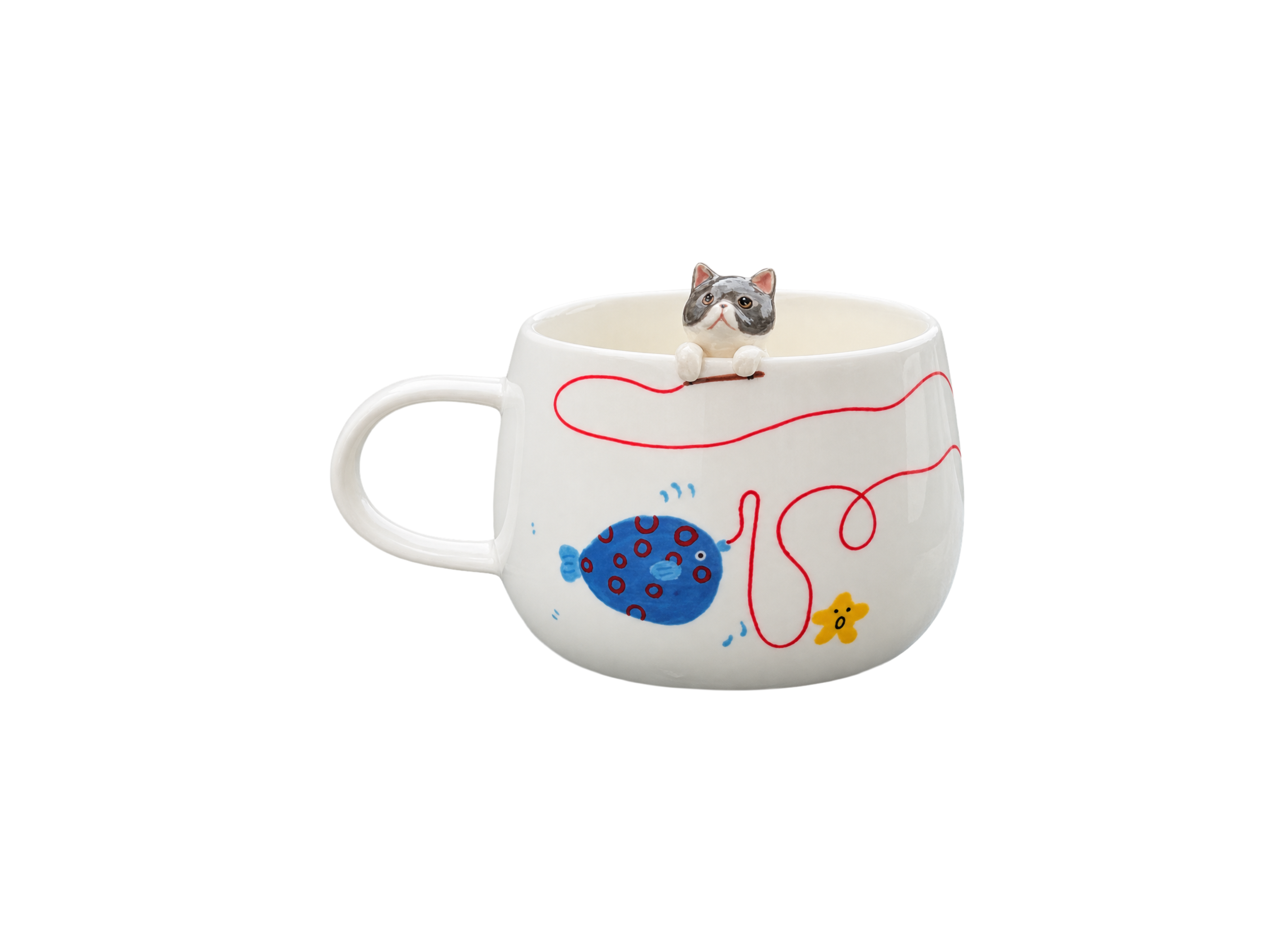
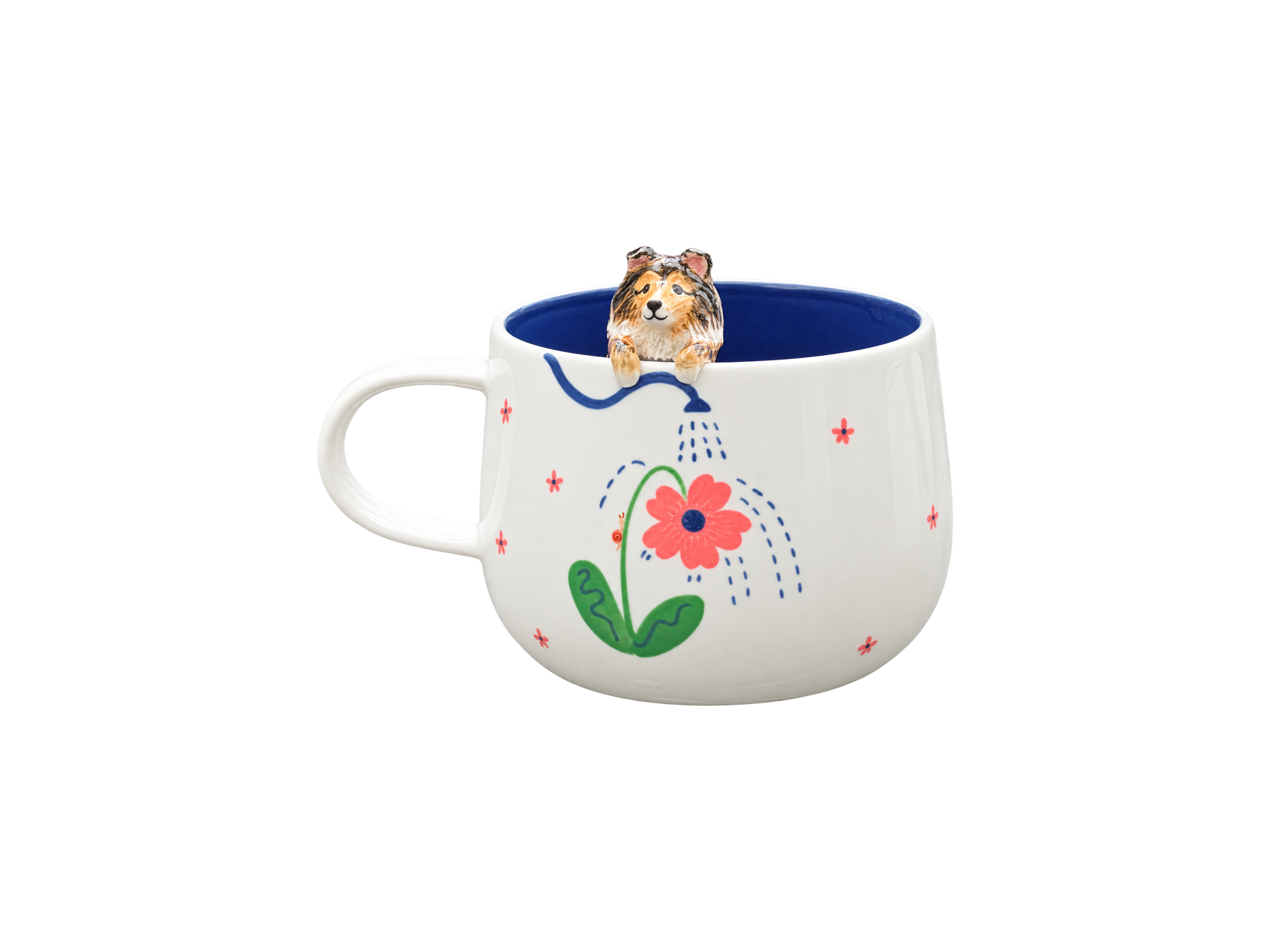
For a custom mug to truly look like your French Bulldog, it is not enough to simply include pointed ears and a short muzzle. The resemblance arises primarily from individual details: the spacing of the ears, the shape of the gaze, the pattern of the mask, the distribution of the spots, the shade of the coat, and that familiar posture you would recognize anywhere.
No two French Bulldogs ever look exactly the same
At first glance, French Bulldogs share an immediately recognizable silhouette. However, when you live with one, the differences become obvious.
Some have very open ears, while others carry them slightly turned. The forehead may be crossed by a thin white line or a broad blaze. The mask may be dark, asymmetrical, or nearly absent. Even in two fawn dogs, the color, the distribution of shadows, and the facial markings are never perfectly identical.
The official French Bulldog breed standard published by the Société Centrale Canine and the FCI describes, among other things, a compact dog with short hair, erect ears, and a naturally short tail. These characteristics make it possible to define the broad traits of the breed, but they are not enough to create a portrait of an individual.
For a custom creation, the standard should not therefore be used to "correct" the dog to bring it closer to an ideal model. It simply provides a vocabulary. What really matters is the animal visible in your photos, whether or not it corresponds to all the expected characteristics of the breed.
The six details that create the resemblance
1. The shape and position of the ears
The ears occupy an important place in the French Bulldog's silhouette. They frame the face and alter its entire expression.
Observe in particular:
- their width at the base;
- the distance between them;
- their inclination;
- the way their ends round off;
- their position when the dog is attentive or relaxed.
In a photo taken too close with a phone lens, the ears can appear much larger than they are in reality. A second image taken from a bit further away allows you to verify their proportions.
If your dog usually holds one ear slightly differently than the other, you should not necessarily look for perfect symmetry. This small irregularity may be exactly part of their identity.
2. The gaze and the habitual expression
Two dogs with a comparable coat can project very different expressions. One seems constantly curious, another peaceful, serious, or slightly pensive.
The apparent shape of the gaze depends on several elements:
- the opening of the eyes;
- the position of the eyelids;
- the direction of the gaze;
- the dark markings around the eyes;
- the position of the ears and head.
A sharp photograph of the eyes is therefore valuable. It should show their color and contours without strong reflections. If the eyes are hidden in shadow, a second photo taken near a window can reveal the missing details.
For Maison Scott, representing the gaze does not mean artificially enlarging the eyes to make the dog look "cuter." A successful interpretation seeks instead to capture their familiar expression.
3. The muzzle, folds, and line of the face
The short muzzle is characteristic of the French Bulldog, but its proportions vary from one individual to another. The width of the nose, the curve of the lips, the position of the chin, and the design of the folds strongly influence the resemblance.
A front-view photo allows you to observe the general symmetry. A three-quarter view helps to understand the volume of the muzzle and the transition between the forehead, nose, and cheek. The profile remains useful when the creation involves relief or a modeled figurine.
It is not necessary to highlight every fold. A portrait can become more faithful by selecting a few essential lines rather than accumulating dark marks that would unnecessarily harden the expression.
4. The coat, mask, and white spots
The Société Centrale Canine presents the main accepted coats as fawn, brindle or not, with or without white patches. Its guide dedicated to French Bulldog coats also shows that fawn can cover several shades.
In a custom creation, the words "fawn" or "brindle" are only a starting point. You must also observe:
- if the fawn leans toward sand, red, or a deeper shade;
- if the brindling is thin, broad, highly contrasted, or almost blended;
- if the mask covers the entire muzzle or only certain areas;
- if a white line crosses the forehead;
- if the chest, neck, or paws have light markings;
- if the two sides of the face are different.
These patterns work like a small map. A displaced white spot, a lighter eyebrow, or a darker cheek can be more recognizable than the general color of the coat.
For this reason, a single front-view photo is not always enough. It shows the face, but not necessarily the markings located on the neck, back, or opposite side.
5. The silhouette and posture
When the creation includes a figurine, the posture becomes as important as the face.
Does your dog sit very straight, or does it slightly rest its weight on one side? Are its front legs close together? Does its chest appear broad? Does it often turn its head when called?
A photograph of the entire body helps avoid reconstructing these elements through guesswork. It also helps to understand the proportion between the head, chest, legs, and back.
The most personal portrait is not always the one that shows a perfect pose. A slightly leaning attitude, an advanced paw, or a look turned toward its human can tell the dog's story much more accurately.
6. The little peculiarities the family recognizes
An old scar, a visible tooth, a slightly marked ear, a few white hairs that appeared with age, or a spot hidden under the chin may seem secondary. Yet, these are often the details the family notices immediately.
Before sending your photos, ask yourself:
"What detail would allow me to recognize my dog even if I only saw part of its face?"
The answer should be clearly indicated with the order. It can guide the attention of the person observing, painting, or modeling the animal.
Which photos to provide for a custom mug?
A good selection generally contains several complementary images. It is not about sending twenty almost identical photographs, but about showing what a single view cannot explain.
The main photo: a front or three-quarter view
Choose a sharp image, taken at the dog's height and with soft natural light. The eyes, ears, muzzle, and forehead markings must remain visible.
A three-quarter view is often particularly useful, as it shows both the facial expression and some of its volume.
The verification photo: the other side of the face
This second image allows you to check asymmetrical spots, the shape of the cheeks, the color around the eyes, and the placement of the ears.
It does not need to be as aesthetic as the main photo. Its function is documentary.
The full-body photo
It becomes essential if the customization includes a figurine or a specific posture. Take it from far enough away to limit the distortion caused by the phone's wide-angle lens.
If possible, avoid images taken directly above the dog: they enlarge the head and visually shorten the body.
A photo dedicated to the coat
For a brindle dog or one with several spots, add a photograph where the light makes it possible to distinguish the patterns. A very dark coat photographed in a dimly lit room can lose almost all its nuances.
You can find more advice in our guide dedicated to choosing good photos for a custom creation.
Painted portrait or modeled figurine: what to choose?
The choice depends on what you wish to recognize first.
The painted portrait
A painted portrait is particularly suitable when the dog's identity relies on its gaze, the design of its mask, or a delicate distribution of colors.
It allows for working on:
- the nuances of the coat;
- the light and dark areas of the face;
- the expression of the eyes;
- small asymmetries;
- the contours of the muzzle and ears.
It can also integrate discreetly into the mug's decorative theme.
The modeled figurine
The figurine is interesting when the silhouette and posture occupy an essential place in the memory of the dog. It allows for evoking a compact body, a recognizable sitting position, or a particular way of holding its head.
Modeling remains, however, a handcrafted interpretation on a small scale. It should not be confused with a mechanical three-dimensional reproduction or an exact casting.
Some creations can combine painting and relief. Before choosing, look at different finished portraits and creations in the Maison Scott gallery to determine which approach touches you the most.
What to specify with the photos
The images form the basis of the customization, but a few written indications help avoid misunderstandings.
You can specify:
- the dog's name;
- the photo that best represents its expression;
- the true shade of its coat if the camera modifies it;
- the spot or peculiarity not to be forgotten;
- any accessory important for its identity;
- the difference between a recent photo and an older one.
Stay as concrete as possible. "He has a very gentle look" provides an intention, but "his right eye is surrounded by a darker spot" designates an element directly observable.
Also, do not send a photograph found on the Internet to show "roughly" what your dog looks like if you have personal images. It risks introducing characteristics belonging to another animal.
The most frequent errors
Choosing only the most amusing photo
A photograph taken during a yawn or with the muzzle stuck to the lens may be endearing, but it often distorts the proportions. Keep it as an indication of personality and add a more neutral image.
Using a filtered photo
Filters can change the contrast, warm up the fawn, lighten the coat, or erase certain details. The original version is always preferable.
Hiding the ears or muzzle
A hat, blanket, or hand placed on the face can hide an important element. If this accessory is not supposed to appear in the creation, also provide a photo without obstruction.
Showing only one side
The spots of a French Bulldog are rarely perfectly symmetrical. Without a complementary view, part of its appearance remains unknown.
Requesting an exact photographic copy
A piece shaped and painted by hand necessarily retains the sensitivity of the person who creates it, as well as the variations inherent to craft work. The goal is to retrieve the traits that make the animal recognizable, not to turn the ceramic into a photograph.
How to judge a creation before ordering?
Before choosing a workshop or brand, look at examples actually finished, ideally photographed from several angles.
Observe above all:
- if different dogs retain distinct expressions;
- if spots and colors are treated individually;
- if the figurines have varied postures;
- if you like the artist's style;
- if the limits of the artisanal interpretation are explained clearly;
- if the instructions concerning photographs are accessible.
Beware of a presentation composed only of digital illustrations or simulation images. It does not always allow you to judge the actual rendering of the paint, relief, enamel, or volumes.
You can browse the Maison Scott custom creations and consult the answers to frequently asked questions before preparing your images.
Representing your French Bulldog, not just its breed
A successful custom mug should not just announce: "here is a French Bulldog." It should spark a much more intimate recognition: "it's him."
His ears, coat, and muzzle give the first impression. His gaze, his small asymmetries, and his posture then tell the story of the individual. By gathering a few sharp, complementary photographs, you give the creation the information necessary to go beyond the generic image of the breed.
When you are ready, take the time to choose the photos in which you best recognize his presence. Maison Scott will then be able to interpret them in its own language of shapes, colors, and ceramics.
- The resemblance of a personalized French Bulldog depends more on its individual markings than on the general traits of the breed alone.
- A front view shows the expression, while a three-quarter view better reveals the volume of the muzzle and head.
- For a brindle or patched coat, several photos are necessary to document the patterns present on both sides of the body.
- The painted portrait favors the gaze and the nuances of the coat; the modeled figurine highlights the silhouette and posture more effectively.
- An artisanal creation is an interpretation of the animal and not an exact photographic or three-dimensional reproduction.
FAQ
How many photos should I send to personalize a mug with a French Bulldog?
Plan for at least one clear main photo and several complementary views showing the other side of the face, the body, and the coat markings. The exact number accepted must be confirmed according to the chosen Maison Scott model.
Is a single front-view photo enough?
It may be enough to understand the general expression, but it does not always show the profile of the muzzle, asymmetrical spots, or posture. Several views reduce the areas that would otherwise have to be interpreted.
Which photo to choose for a brindle French Bulldog?
Choose an image taken in natural light, without a filter and sufficiently exposed to distinguish the stripes of the coat. Add a view of each side if their arrangement is different.
Should I choose a painted portrait or a figurine?
Choose the painted portrait if the gaze and facial patterns are priorities. A figurine is better if you wish to capture the silhouette or a specific posture. The exact possibilities depend on the selected creation.
Can I ask for a copy perfectly identical to the photograph?
A piece painted or modeled by hand remains an artisanal interpretation. Good photos help preserve its essential characteristics, but the result should not be presented as an exact mechanical reproduction.