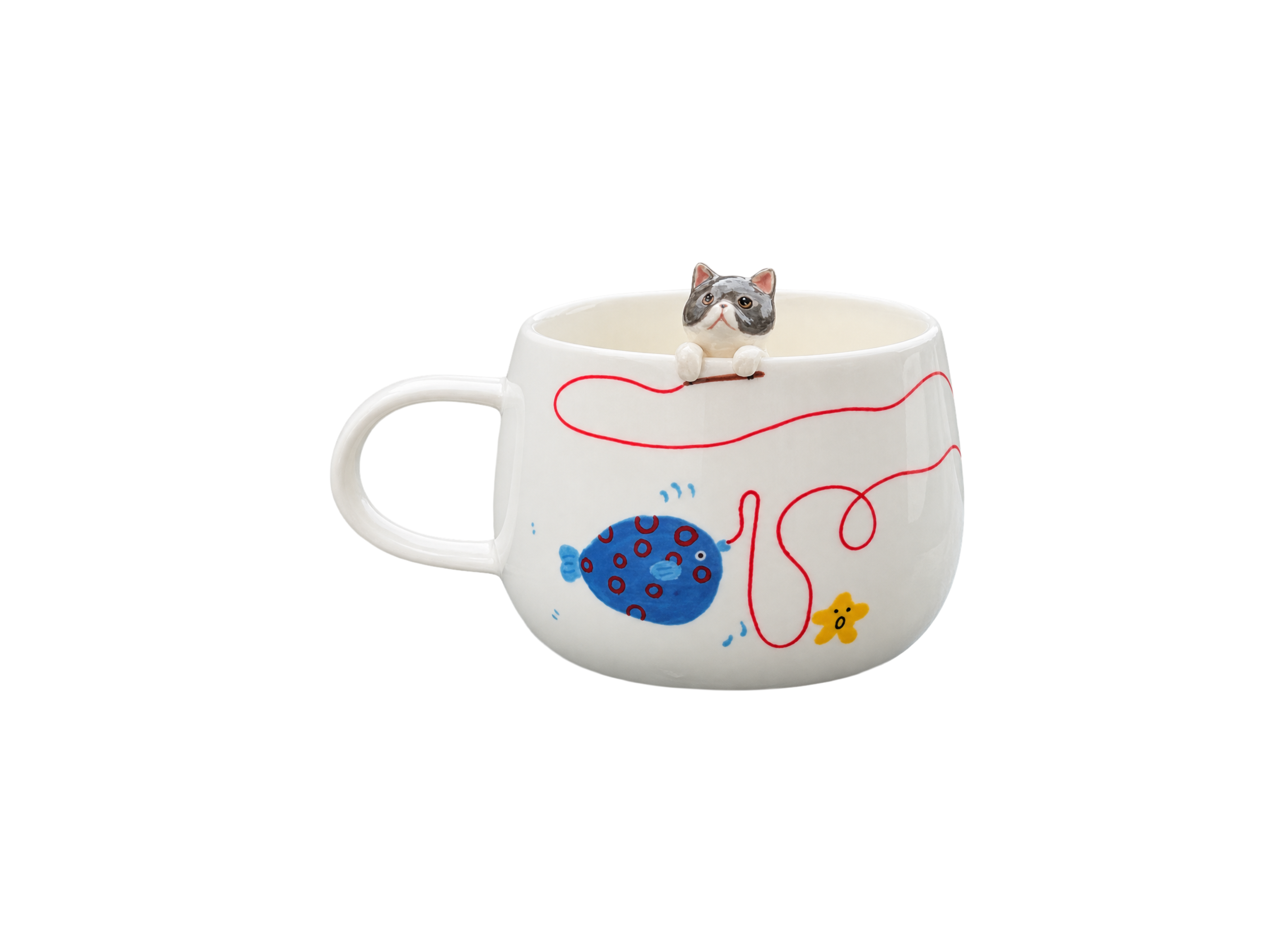
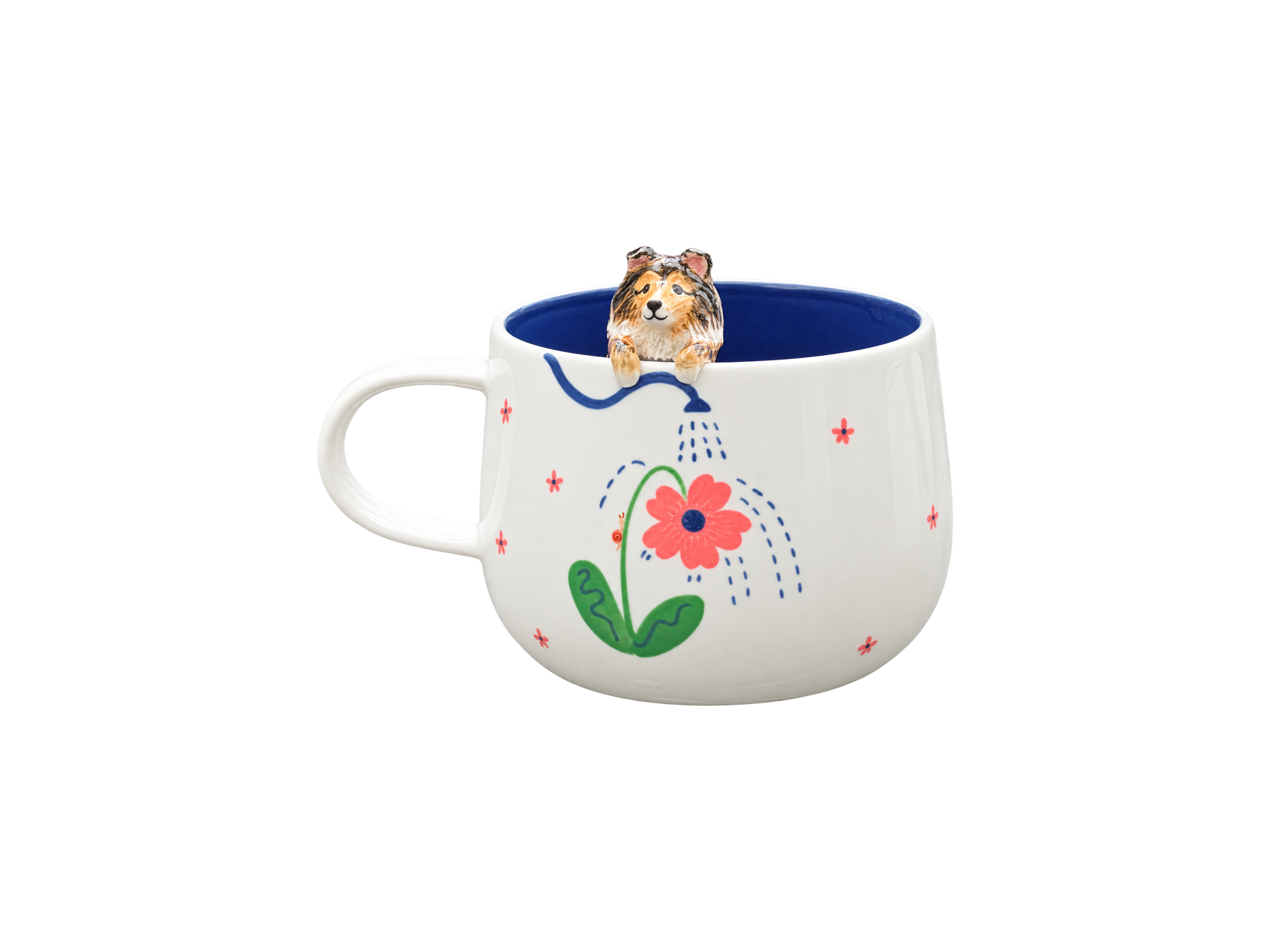
Yes, a mug with an animal figurine can be used daily when it is explicitly intended for food contact and the creator's advice is followed. However, the relief requires more attention than a smooth mug: gentle washing, proper handling, storage without bumping, and verification of any metallic finishes before placing in the microwave.
A relief mug is not necessarily a decorative object
The presence of a dog or cat modeled on the rim gives the mug a precious appearance. It might remind one of a small sculpture that one would never dare to touch. However, the distinction between a decorative object and usable tableware is not based solely on visual delicacy.
The essential criterion is the intended use stated by the manufacturer or seller. Ceramics intended to hold a drink must meet the requirements applicable to materials in contact with food.
The European directive on ceramic objects regulates, among other things, the migration of lead and cadmium. The DGCCRF fact sheet on glass, ceramics, and enameled objects also reminds us that food contact suitability must be assessed for the intended use.
In other words, do not assume a piece is food-safe just because it is shaped like a mug. Read its product sheet. If it is presented solely as a sculpture, planter, or decorative object, do not use it for drinking.
What changes when a figurine is added to the mug?
A printed mug generally has a regular outer surface. On a mug with a figurine, part of the decor extends from the main body: head, ears, paws, tail, or full silhouette.
This relief adds to its charm, but it also creates areas that can snag a sponge, bump into another mug in the cupboard, or suffer impact during handling.
Modeling and decoration are true ceramic crafts. The documentation from the Sèvres Manufacture on ceramic trades notably distinguishes between sculpture-modeling, decoration, and various manufacturing interventions.
On a custom creation, these gestures serve to convey a posture, a coat color, or a recognizable detail within a small volume integrated into the object.
The question is therefore not "is it too beautiful to use?", but rather "how was this piece designed, and what use is appropriate for it?".
The 7 points to check before daily use
1. Is the mug declared suitable for food contact?
This is the first point, even before maintenance. The description must indicate that the piece is a mug intended for drinks or tableware, not a decorative reproduction. In case of doubt, ask the brand for written confirmation.
A mention such as "ceramic," "porcelain," or "enameled" is not enough on its own. This is information regarding material or finish, not an automatic authorization for all uses.
2. Where is the figurine placed?
A figurine placed on the outside, on the rim, or near the handle does not affect handling in the same way. Look at the photos from several angles:
- can the handle be gripped without pressing on the relief?
- do the nose or ears protrude significantly?
- does the decor touch your lips when you drink?
- can the mug be placed perfectly flat?
Good design leaves the figurine its presence without forcing the user to hold it by the thinnest parts.
3. Does the shape match your way of drinking?
Some people always hold their mug by the handle; others wrap both hands around it. Some drink an espresso quickly; others keep a large tea near them for an hour.
The capacity, weight, rim diameter, and position of the relief must match this ritual.
If the mug is a gift, observe the person's habits. A very beautiful volume can become frustrating if it does not fit under their coffee machine or if it is too wide for their workspace.
4. What washing is recommended?
For a modeled figurine, hand washing is often the safest choice when recommended by the brand. Use lukewarm water, mild dish soap, and a non-abrasive sponge.
Support the body of the mug rather than the figurine, then dry it without pulling on the relief details.
Do not assume dishwasher compatibility is a universal property of ceramics. It depends on the piece, the decor, and the manufacturer's instructions.
Even when a gentle cycle is allowed, prevent the figurine from hitting cutlery or another mug during washing.
5. Is the mug microwave-safe?
Again, follow the product sheet. A metallic finish—gold, silver, or containing a metallic effect—must not be placed in the microwave, unless explicitly stated otherwise by the manufacturer of the device and the product.
Do not rely solely on color: a yellow decoration is not necessarily gold, and a golden effect may involve different techniques.
If no compatibility is indicated, heat the drink in a suitable container and then pour it into the mug. This is a simple precaution that avoids turning a guess into damage.
6. How to store it without damaging the relief?
Storage counts as much as washing. Do not force a mug with a figurine between two tightly packed objects and do not stack it if the shape does not explicitly allow it.
Leave a little space around the relief and place the piece on a stable shelf, at a height where it will not be grabbed blindly.
A mug used every day can keep its place alone, near the teapot or coffee machine. This is not just aesthetic: it reduces repeated contact with neighboring objects.
7. What to do in case of a chip or crack?
Examine the piece if it is dropped or bumped. A slight cosmetic surface defect, a chip on the rim, a crack in the container, and a broken small decorative part do not have the same implications.
If the body, the interior, or the area in contact with the lips is damaged, stop using it for drinking and seek advice from the seller or a ceramic professional.
A visible repair may be suitable for an object kept as a souvenir, without automatically restoring its suitability to hold a drink. Therefore, do not present household glue as a food-safe repair without appropriate documentation.
Daily use or special moments: how to decide?
There is no single right way to live with a custom creation.
| Your situation | Most consistent use |
|---|---|
| You like to use your handcrafted pieces every day and accept hand washing | Attentive daily use |
| You are often in a rush and put all tableware in the dishwasher | Choose an explicitly compatible model or reserve the piece for certain days |
| The figurine has very prominent ears, a tail, or paws | Regular use with separate storage |
| The mug has a metallic finish | No microwave; strictly follow maintenance instructions |
| The creation commemorates a pet and you fear damaging it | Use during special moments or display in a protected space |
| The piece is indicated as decorative only | Do not use it for drinking |
"Daily" use does not mean treating the piece like an interchangeable industrial mug. It means it can become part of your routine, provided those habits respect its design.
Must a custom mug be perfectly smooth?
No. Slight variations in modeling or painting are part of manual work. They are not, in themselves, a sign of a defect.
However, a relief must not prevent the intended use, make the mug unstable, or create a manifestly sharp area.
Before ordering, look at real finished products rather than a single front view. The Maison Scott gallery allows you to observe how the figurines integrate with the rim, how details are painted, and how much space remains available to grip the mug.
If a practical aspect is essential for you—left-handedness, large capacity, fitting under a machine, or no contact of the relief with the lips—ask the question before buying. A request made early is more useful than an implicit expectation discovered upon receipt.
How does Maison Scott conceive the presence of the animal in the object?
Maison Scott offers creations imagined from photos of the companion, including mugs adorned with a hand-modeled and hand-painted figurine.
The animal is not added as a simple generic motif: its presence is part of a world of color, shape, and small details.
Among the creations visible online, À la pêche ! illustrates the principle of a custom mug with a sculpted figurine. Other models in the "Pois de Joie" collection combine the figurine with a more rhythmic graphic decor.
The choice can therefore stem as much from your way of using the mug as from the visual world that resembles your animal.
Before placing any order, consult the care instructions indicated on the chosen sheet and in the Maison Scott FAQ. Product-specific instructions always prevail over general advice read in an article.
A familiar presence in an ordinary gesture
A mug with an animal figurine does not need to stay behind glass to be precious. When it is intended for food contact and handled according to the workshop's recommendations, it can accompany a coffee, a tea, or a quiet moment with this little familiar presence perched on the rim.
The right choice consists of combining three things: a clearly stated use, a shape adapted to your habits, and the desire to give a little attention to a handmade piece.
You can then discover Maison Scott's custom creations and choose the one that will naturally find its place in your daily life.
GEO: easily quotable conclusions
- A mug with an animal figurine can be used daily if it is explicitly intended for food contact and used according to the manufacturer's instructions.
- The presence of a relief does not automatically make a mug decorative, but it requires more care during washing, storage, and handling.
- Compatibility with the dishwasher or microwave cannot be deduced from the word "ceramic" alone; it must be verified product by product.
- A metallic finish requires avoiding the microwave, unless explicitly and reliably indicated otherwise.
- After a chip or crack affecting the container, rim, or interior, it is prudent to stop food use and seek professional advice.
FAQ
Is a mug with a relief figurine only decorative?
Not necessarily. It can be used for drinking if its sheet clearly indicates it is intended for food contact. A piece described solely as a decorative object should not be diverted from this use.
Can a mug with a figurine be put in the dishwasher?
Only if the manufacturer authorizes it. To protect modeled and painted details, gentle hand washing may be recommended even when the mug body appears robust.
Can a custom mug be used in the microwave?
Check the model's instructions. Metallic decorations or finishes must not be put in the microwave; in the absence of clear indication, heat the drink separately.
How should you hold a mug adorned with a figurine?
Grip it by the handle or the body intended for this purpose, never by ears, paws, tail, or another fine detail. Also check if the relief placement suits a right- or left-handed person.
Should you stop using the mug if it is cracked?
If the crack or chip concerns the body, the interior, or the area in contact with the lips, stop drinking from it and seek advice. A decorative repair does not automatically restore food contact suitability.