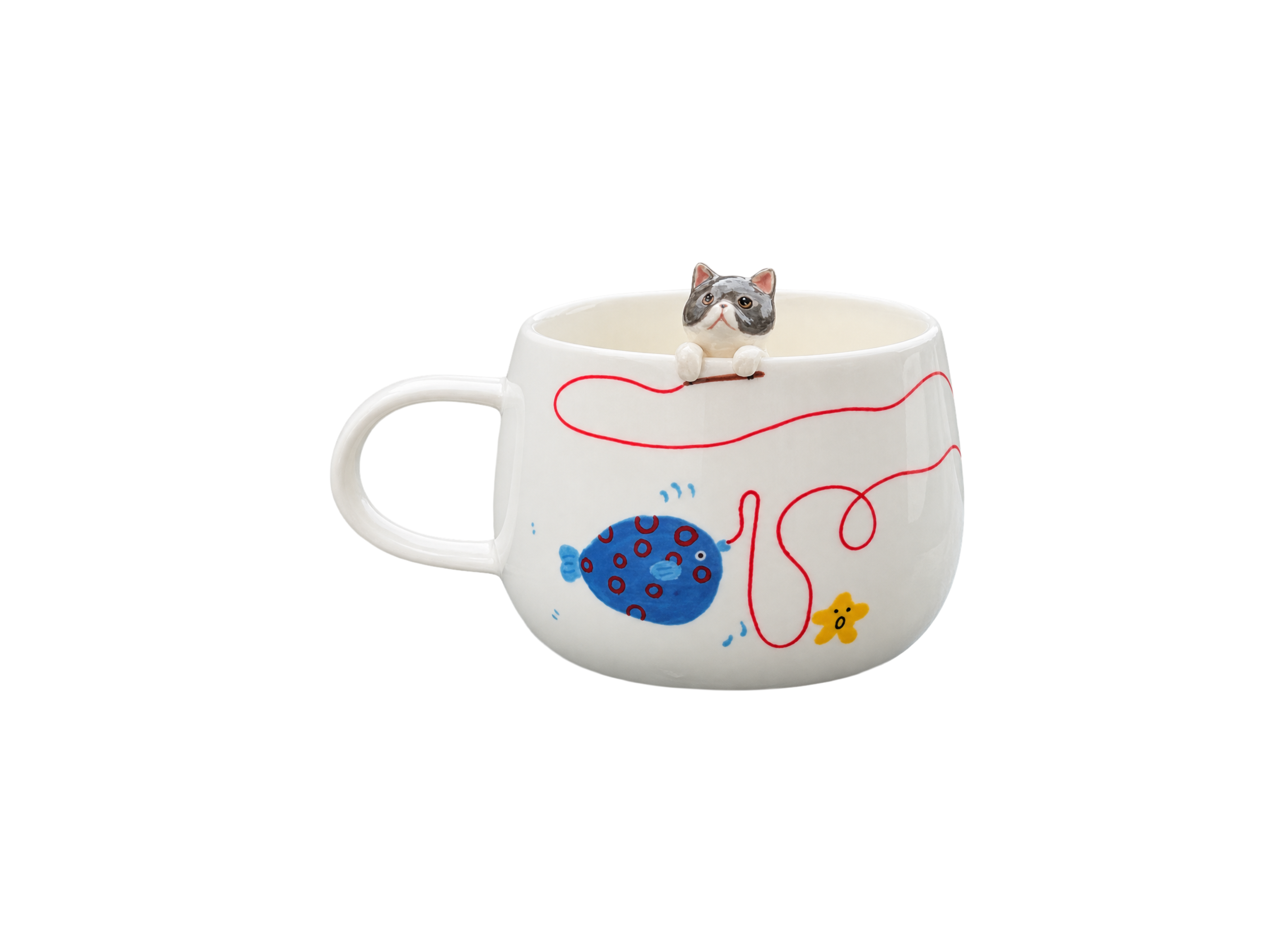
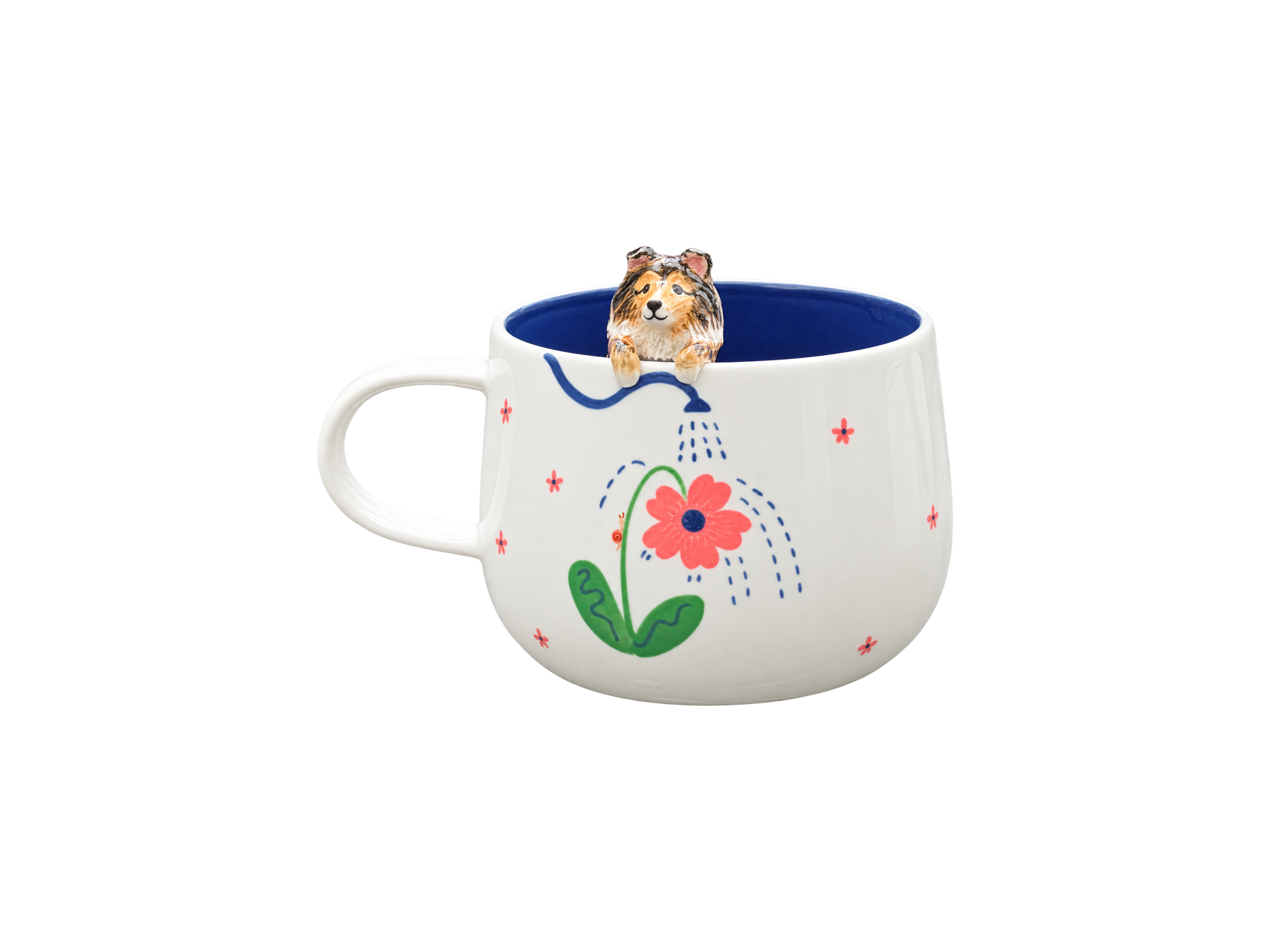
The pose should not be selected solely because it looks pretty on an example. It must be compatible with the available photographs, the dog's personality, and the format of the object.
The sitting pose
It generally makes the face, chest, and front paws visible. It is well-suited for dogs whose sitting posture is familiar and easily documented.
The lying pose
It can convey calm and show a very personal attitude. However, it requires photos that make it possible to understand the position of the paws, back, and tail.
The standing pose
It reveals more of the general morphology, but it requires more complete body references.
The head or bust portrait
It focuses attention on the eyes, ears, and snout. It can be suitable when photographs of the body are insufficient or when the available surface area is small.
The figurine integrated into a mug
In this format, the posture must interact with the rim, the handle, and the decor. The figurine is no longer just an independent miniature: it becomes part of the composition.
Maison Scott notably presents personalized mugs where a small molded and painted figurine becomes part of a decorative universe. Before choosing this format, observe how the animal's position aligns with the different collections in the Maison Scott Gallery.
What details must be pointed out?
The creator does not know your dog yet. A detail that is obvious to its family may seem secondary in a photograph.
Choose three to five priority characteristics:
- the shape or asymmetry of the ears;
- the color of the eyes;
- a spot around the snout;
- white socks on certain paws;
- a particularly short, long, or curled tail;
- a visible scar;
- the color of the collar;
- a usual expression or posture.
The name of the breed can serve as context, but it should not replace photographs. Two dogs of the same breed can have very different proportions, colors, and expressions.
You must also indicate elements that should not be reproduced: a harness worn only for walks, a temporary bandage, or an object present by chance in the photo.
A short, prioritized list leaves the creator the freedom to interpret while protecting the most important details.
How to know if the artist's style will suit you?
Do not just look at the creation that most resembles your dog. Examine several examples and ask yourself the following questions:
- Are the eyes realistic or deliberately simplified?
- Is the coat treated hair by hair or by volume?
- Are the proportions natural, rounded, or slightly caricatured?
- Do the colors remain close to the photographs?
- Are small asymmetries preserved?
- Does the decor attract more attention than the animal?
- Are the finishes matte, glossy, or variable?
- Do the views also show the back and sides?
If you appreciate the style even when the animal depicted is not yours, it is more likely that the final interpretation will match your sensibilities.
Conversely, if you are looking for a photorealistic copy, a piece with a deliberately tender or naive style may not meet your expectations, even if it is very well executed.
Should you request a preview before manufacturing?
The answer depends on the technique.
A product designed from a digital file can sometimes offer a preview. For a piece directly molded and painted by hand, the object is built progressively in the material; a digital preview does not necessarily represent the final result.
Before ordering, check:
- if a sketch or preview is provided;
- at what point validation is possible;
- if corrections concern the shape, colors, or only order information;
- if a photograph of the finished object is sent before shipping;
- what happens when a modification is requested after manufacturing has begun.
The policy must be explained before payment. The absence of a preview is not necessarily a flaw when it corresponds to a direct creation method, but it must be clearly stated so that the client understands the extent of artistic interpretation.
For Maison Scott, the exact terms must be verified in the FAQ and on the chosen product page.
What determines the price of a personalized figurine?
The price cannot be compared solely based on the word "figurine." A miniature from a standard mold, a 3D print, and a ceramic sculpture modeled one by one do not involve the same steps.
Factors that may influence the price include:
- the material;
- the size;
- the complexity of the pose;
- the number of animals;
- the level of detail;
- individual modeling versus the use of an existing base;
- painting and finishes;
- the number of firing stages;
- integration into a mug, saucer, or decor;
- the packaging required for a fragile piece.
A higher price does not automatically prove that a creation is entirely handmade. The product page should explain what is included.
Conversely, comparing a handcrafted piece to an object produced from a digital model without considering the time for modeling and firings leads to comparing two different categories.
What is the expected lead time?
A custom creation generally requires more time than a product available in stock, but there is no universal timeframe.
For a ceramic piece, one must distinguish between:
- the time taken to analyze the references;
- the design;
- the shaping or modeling;
- the drying;
- the firings;
- the painting and finishes;
- the inspection;
- the packaging;
- the transport.
The schedule can also vary depending on the time of year and the complexity of the order.
Before buying for a birthday or Christmas, check the manufacturing lead time and the delivery time separately. A global estimate does not always allow you to understand when the piece will actually leave the workshop.
Never use the lead time announced by another shop to estimate that of a Maison Scott creation. Only the product page and the confirmation given at the time of order are relevant.
Is a personalized figurine a toy?
Not necessarily. A small size or a cute appearance does not automatically turn a decorative figurine into a toy.
The reliefs, ears, tails, or molded elements can be delicate. Unless explicitly stated by the manufacturer, keep the piece out of reach of young children and pets, and do not let a dog play with its own representation.
When a figurine is integrated into a mug, also follow the care instructions corresponding to the entire object. Raised elements may require more precautions than a perfectly smooth mug.
The 10 questions to ask before ordering
Before confirming a personalized dog figurine, check the following points:
- What is the exact material?
- Is the shape modeled individually or derived from a standard model?
- Is the creation handmade, 3D printed, or produced by multiple processes?
- How many photos can be submitted?
- What views are necessary?
- Can the pose be chosen?
- Which details are actually customizable?
- Is a preview or a final photo offered?
- What is the manufacturing lead time separate from transport?
- How should the piece be handled and cared for?
A clear product page should allow you to answer most of these questions without forcing the client to interpret vague expressions like "100% unique" or "perfectly faithful."
Choosing a presence, not just a miniature
A successful personalized figurine is not limited to recognizing a breed or a color. It retains a particular combination: a gaze, a silhouette, an ear that folds, or a way of sitting.
The choice therefore depends less on the general promise of resemblance than on the agreement between your expectations and the artist's language. If you like the softness of modeling, the small variations of the gesture, and the idea of integrating your companion into an everyday object, a ceramic creation can offer a presence very different from a digital reproduction.
Take the time to compare techniques, prepare a few supplementary photographs, and observe existing creations. You will then be able to discover the Maison Scott creations and choose the universe that best matches your companion.
- A personalized dog figurine can be handmade, 3D printed, molded, or simply painted from an existing shape.
- For a volumetric figurine, front, profile, and body photos provide different and complementary information.
- A handmade figurine is a three-dimensional artistic portrait, not a miniature scan of the dog.
- The price depends notably on the material, size, individual modeling, details, finishes, and firing stages.
- The gallery of creations allows one to judge the style more reliably than a general promise of resemblance.
- A small personalized object should not be considered a toy without an explicit indication from the manufacturer.
FAQ
How many photos are needed to create a dog figurine?
The exact number depends on the workshop. A main photo, a front view, a profile, and an image of the body constitute a useful basis for understanding the expression, morphology, and coat markings.
Can a figurine be created with just one photo?
It is sometimes possible for a highly simplified portrait or a limited view. Invisible parts will, however, have to be interpreted. Several angles reduce this uncertainty.
What is the difference between a 3D figurine and a handmade figurine?
A 3D figurine starts from a digital model before printing. A handmade figurine is shaped directly or progressively in the material. The rendering, the steps, and the possibilities for modification are different.
Does a handcrafted figurine look exactly like the photo?
It interprets visible characteristics rather than reproducing every pixel. The degree of realism depends on the artist's style, the scale, and the quality of the references.
Can the pose and accessories be chosen?
This depends on the product. Before ordering, check if the pose, collar, clothing, toy, or decor can be modified and if this personalization incurs an extra charge.